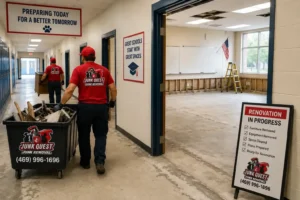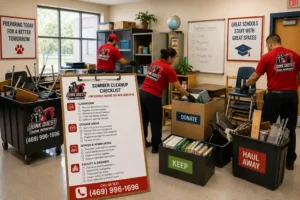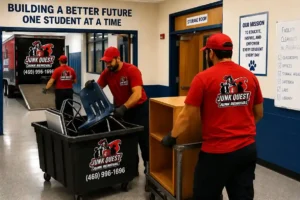
Schools should organize classrooms before fall by first removing broken furniture, outdated materials, surplus equipment, and unnecessary clutter. Once the space is fully cleared, teachers can arrange furniture, organize storage, and label essential supplies more effectively. This creates a cleaner, more functional classroom for the new school year.
Key Takeaways
- Classroom organization starts with removal, not arrangement. Broken furniture, surplus items, outdated materials, and full storage cabinets all need to go before any organization system can work.
- Research compiled by Edutopia on classroom environment design shows that physical clutter in a learning space raises cognitive load for students.
- The American Psychological Association identifies physical clutter and spatial disorganization as contributors to reduced student attention and increased anxiety.
- NAEYC recommends clear, unobstructed circulation pathways between activity zones in early childhood classrooms. This principle extends across grade levels.
- Classroom organization by zone (student seating, teacher workstation, storage stations, technology area, collaborative corner) needs a fully cleared starting point. Professional removal creates that starting point.
- Junk Quest prices classroom decluttering and removal by trailer volume. Cost includes labor, hauling, taxes, and disposal.
Why Does Classroom Organization Affect Learning Outcomes?
Classroom organization affects learning outcomes because the physical arrangement and clutter level of a room directly shapes how students process information and how teachers deliver instruction. Research compiled by Edutopia on classroom environment design shows that physical clutter raises cognitive load for students. Younger learners are especially sensitive to visual and environmental distractions. Because of this, students end up filtering irrelevant visual information before they can even focus on instruction.
The American Psychological Association identifies environmental stressors, including clutter, noise, and spatial disorganization, as contributors to reduced attention and increased anxiety in school-age children. These effects can persist through the semester if the underlying space issues stay unresolved. That’s why addressing classroom organization before opening day matters. It removes these stressors before they can affect learning outcomes for the full academic year.
What Must Be Removed Before Classroom Organization Can Begin?
Classroom organization only works in a cleared space. Four categories of items need to go first.
Broken and surplus furniture takes up floor space and blocks proper layouts. This includes desks with structural damage and non-functional storage units. A crew removes this through furniture removal in a single visit.
Accumulated storage cabinet contents block the storage capacity organization systems depend on. This includes multi-year unclaimed materials and duplicate supply stocks.
Outdated instructional materials and technology take up shelf and floor space teachers need for current materials. This includes broken AV equipment and legacy devices.
Post-summer renovation debris must clear out before organization work can begin in that zone. This includes packaging materials and replaced fixture components.
The complete accepted items list is on the Items We Take page.
What Are Classroom Organization Ideas by Zone?
Once a classroom is cleared, organization applies zone by zone. Each zone serves a distinct instructional function.
Student seating and work areas should match the instructional model. Rows support direct instruction. Clusters support collaborative work. U-shapes support discussion-based learning. The arrangement should reflect how the room is actually used.
NAEYC recommends that early childhood classrooms maintain a minimum of 35 square feet of usable floor space per child, with clear pathways between activity zones. This standard applies primarily to early childhood settings, but the underlying principle of clear circulation extends across grade levels.
The teacher workstation and instructional wall should stay free of personal clutter and non-instructional items. A cleared station with organized surface space reduces setup time at the start of each lesson.
Storage and supply stations work best when teachers group supplies by function and label them clearly at student eye level.
The technology and AV zone needs a designated charging station and a clear cable management system. Otherwise, non-functional or outdated technology left uncleared creates confusion about which devices are actually in active use.
Finally, the reading and collaborative corner works best when it sits apart from direct instruction zones, whether through furniture arrangement or visual markers.
How Should Schools Organize Classroom Storage Before the School Year?
Classroom storage organization follows four principles.
First, clear before you organize. No storage system works in a cabinet already full of items from prior years, so every cabinet and shelf needs to be emptied, sorted, and cleared first. This is the same sort-and-stage process covered in how to get rid of office furniture responsibly in North Dallas.
Second, group by function, not by item. Store supplies used together together, since organizing by item type creates unnecessary movement between stations during instruction.
Third, label at the point of use. Labels belong at the eye level of the students who will access them, not at teacher eye level. See this guide to donating vs. disposing of old furniture for sorting tips before storage day.
Fourth, leave capacity for growth. No storage station should be filled to capacity on setup day. Leaving 20 to 30 percent of cabinet and shelf capacity open allows for new materials and restocking without disrupting the system during the year.
How Does Junk Quest Enable Classroom Organization in North Dallas Schools?
Classroom organization ideas only produce results once the classroom has been cleared first. Junk Quest provides commercial classroom removal for North Dallas school districts across McKinney, Frisco, Allen, Plano, Prosper, Wylie, and Garland. Crews clear broken furniture, surplus equipment, accumulated storage contents, and outdated materials in a single visit before teachers receive campus access.
Every job starts with an on-site walk-through. The crew confirms item categories, separates donation-eligible materials from disposal volume, and assesses load size before moving any item. For how classroom removal fits within the full school facility preparation sequence, see commercial junk removal and cleanouts in North Dallas.
How Much Does Classroom Decluttering and Removal Cost in North Dallas?
Junk Quest prices classroom decluttering and removal in North Dallas by trailer volume. Cost includes labor, hauling, taxes, and disposal. A single classroom with light surplus typically needs less capacity and time than a multi-classroom job, a full wing clearout, or a large district campus job requiring multi-trailer coordination. The crew lead confirms all pricing on-site, after walking the designated rooms with the facilities contact before loading begins.
Request a Classroom Removal Quote
Need help planning a classroom decluttering project? Facilities managers can contact Junk Quest to schedule an on-site assessment. Junk Quest is backed by 900+ reviews and offers a no-obligation upfront quote based on the scope of the removal.
Call (469) 996-1696 or visit Junk Quest to arrange a convenient evaluation. Junk Quest, 7149 Van Tuyl Pkwy, McKinney, TX 75070.
Frequently Asked Questions
1. What is the first step in classroom organization before the school year?
The first step is removing all broken furniture, outdated materials, surplus equipment, and accumulated storage contents from the classroom before any organization work begins. A classroom that still contains items from prior years can’t be effectively organized, since existing clutter blocks the storage and floor space organization systems require.
2. What classroom organization ideas work best for North Dallas schools?
Zone-based furniture arrangements matched to the instructional model, function-grouped storage stations labeled at student eye level, a cleared technology zone with cable management, and a physically separated reading or collaborative corner all produce the most consistent results. All of these require a fully cleared starting point.
3. How much does classroom decluttering cost before the school year?
Pricing is based on trailer volume and includes labor, hauling, taxes, and disposal. A single classroom needs less capacity than a multi-classroom or full-building job. The crew confirms all pricing on-site before setting a final price.
4. Can teachers organize a classroom without professional removal first?
Organizing around broken furniture, full storage cabinets, and surplus items from prior years tends to produce temporary arrangements that revert to clutter within the first weeks of school. Professional removal before teacher setup day creates the cleared starting condition that makes an organization system sustainable.
5. Does the APA have guidance on classroom environment and student learning?
Yes. The American Psychological Association identifies physical clutter, spatial disorganization, and environmental stressors as contributors to reduced attention and increased anxiety in school-age students. Addressing classroom organization before the school year removes these stressors before they can affect learning outcomes.
6. When should North Dallas schools schedule classroom removal for organization?
Schools should schedule classroom removal in the first two weeks of June. This gets rooms ready for janitorial deep cleaning by late June and for teacher setup in early August, since August scheduling tightens as district opening deadlines approach..