A summer cleanup checklist for schools should cover classroom clearing, storage room sorting, furniture and equipment disposal, and general facility decluttering, all scheduled to finish before staff and students return for the fall semester. Summer is the standard window for this work since classrooms and shared spaces are otherwise in daily use during the school year, leaving little time for a full sort. Breaking the checklist into early, middle, and late-summer phases keeps the work manageable rather than compressed into the final weeks before fall.
Key Takeaways
- Summer is the only extended window for full facility work without disrupting daily school operations.
- Splitting the job into early, mid, and late phases avoids compressing everything into August.
- Classrooms, storage rooms, and furniture each need a separate sorting pass.
- Functional furniture and equipment should be donated rather than thrown away when replaced.
- A professional service is generally more efficient for large volumes or district-wide projects.
- Work left unfinished carries into the school year, when there is less time and space to handle it.
Why Is Summer the Right Time for a School Cleanup?
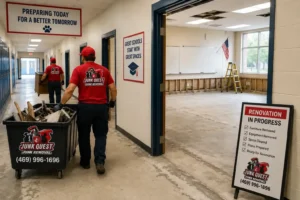
With the building empty, work that would otherwise require scheduling around students and staff moves faster and more safely. Large furniture removal and storage room reorganization are the clearest examples, since both need open corridors and staging space that are not available mid-year.
Starting in June rather than August also leaves a buffer for tasks that run long. Roof, HVAC, and flooring issues discovered during a clear-out often need a contractor, and those lead times are what push projects past the first day of school.
What Should Be Cleared Out of Classrooms Over the Summer?
Classrooms should be cleared of outdated instructional materials, broken or unused furniture, personal items left behind by students or teachers, and general clutter that built up over the years. Teachers often leave part of this sorting to facilities staff or a cleanup crew, since end-of-year teardown rarely allows time for a full declutter.
Office cleanout services cover a similar sorting process for administrative spaces, and the same sequence applies to classrooms.
Summer Cleanup Checklist by Phase
| Phase | Tasks | Timing |
| Early summer | Classroom teardown, initial sorting, storage inventory | First 2 to 3 weeks after school ends |
| Mid-summer | Furniture and equipment removal, deep cleaning, repairs | Weeks 4 to 8 of the break |
| Late summer | Final storage organization, classroom setup, safety walkthroughs | Final 2 to 4 weeks before fall |
How Should Storage Rooms Be Handled During Summer Cleanup?
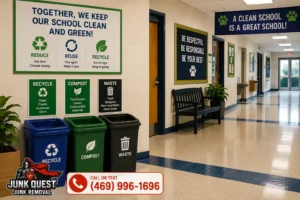
Storage rooms should be fully inventoried, sorted into keep, donate, recycle, and disposal categories, and cleared of anything no longer needed before the new school year adds more material to the space. Storage clean-out services cover this process for facilities that have accumulated clutter over time, which applies directly to school storage rooms reviewed on a break schedule.
What Should Be Done With Furniture and Equipment No Longer Needed?
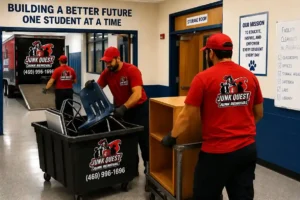
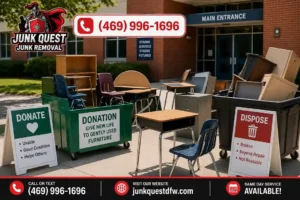
Furniture and equipment no longer needed should be sorted into donation, recycling, or disposal categories rather than left in a hallway or storage room for the next school year. Functional furniture replaced during an upgrade is commonly donatable, as covered in donating office furniture instead of throwing it away, which applies the same way to school furniture turnover.
Should Summer Cleanup Be Handled by Staff or a Professional Service?
Facilities staff can handle routine, smaller-scale tasks. A professional service is generally more efficient for large volumes of furniture, multiple classrooms, or district-wide projects with a fixed deadline before fall.
Scale is the deciding factor, and national facility data suggests the pressure is common. In the National Center for Education Statistics report Condition of America’s Public School Facilities: 2012-13 (NCES 2014-022, March 2014), 21 percent of public schools rated the overall condition of their permanent buildings as fair and 3 percent as poor. What benefits professional office junk removal provides applies directly to projects at this scale.
Lifting is the other consideration. OSHA ergonomics guidance covers the musculoskeletal injury risks that come with repetitive lifting and awkward carries, which is the same exposure profile as any commercial moving or cleanout work.
What Happens If Summer Cleanup Isn’t Completed Before Fall?
Unresolved clutter and disorganized storage carry into the school year, when there is far less time or space to address them. Classrooms and shared spaces start the year less organized than planned, and facility issues that could have been handled over the break get pushed into a busier fall schedule.
Where Junk Quest Serves
Junk Quest is insured and locally operated out of McKinney, handling commercial cleanout work for schools acrossMcKinney, Frisco, Allen, Plano, Prosper, Wylie, and Garland. That covers classroom, storage, and furniture removal on a break schedule. Office junk removal across North Dallas covers the same process for business facilities.
What Should Schools Include in a Summer School Cleanup?
A summer school cleanup should cover classroom clearing, storage room sorting, furniture and equipment removal, deep cleaning, repairs, and final safety checks before fall. Starting early in summer gives schools enough time to remove unwanted items, organize remaining materials, and prepare classrooms without disrupting the new school year.
Schedule Your Summer School Cleanout
Planning facility work before the fall semester? Call Junk Quest at (469) 996-1696 or visit Junk Quest for a no-obligation upfront quote. Backed by 900+ reviews.
Junk Quest
7149 Van Tuyl Pkwy, McKinney, TX 75070
(469) 996-1696
junkquestdfw.com
Frequently Asked Questions
1. How is a summer school cleanout priced?
Pricing is based on the volume of material removed rather than a set per-project figure. Multi-classroom and district projects usually land higher because of volume. Junk Quest provides a no-obligation upfront quote before work begins.
2. Who needs to coordinate campus access during the break?
A facilities contact or custodial lead typically handles keys, alarm codes, and gate access, since most buildings are locked down between semesters. Confirming loading points and parking in advance prevents delays on the first day.
3. What documentation does a district usually require before work starts?
Most districts request proof of commercial liability insurance and route the job through a vendor approval process. Junk Quest is insured. Confirming coverage requirements early matters, since approval can take longer than the removal itself.
4. Can a school cleanout be split across multiple visits?
Yes. Splitting the work matches the phase structure most schools already follow, with classroom teardown early and final removal closer to fall. Multiple visits also help when staging space is limited.
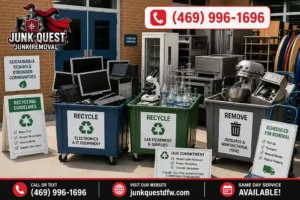
5. What happens to electronics and lab equipment removed from a school?
Electronics are separated for recycling rather than general disposal. Lab and cafeteria equipment is sorted the same way as furniture, with functional items routed to donation where a receiving organization is available.