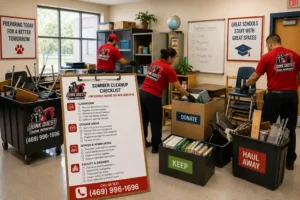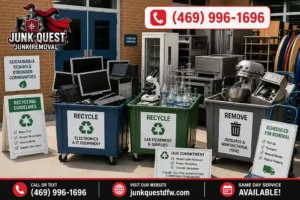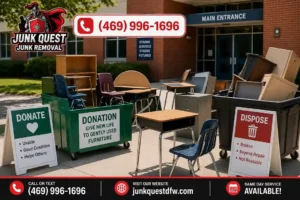
Schools prepare for renovations by clearing furniture, equipment, and stored items out of the affected areas before construction begins, then sorting what gets donated, relocated, or discarded. This clearing work happens well before contractors arrive. Crews cannot work efficiently or safely around furniture left in place, and a space that is only half cleared stalls the schedule on day one. Building the cleanout into your renovation timeline, instead of treating it as a last-minute job, keeps the project moving from the start.
Key Takeaways
- Pre-renovation cleanout and construction debris removal are two separate jobs with different timing and different handling.
- Clearing runs 2 to 4 weeks ahead of construction, after a planning phase 6 to 8 weeks out.
- Displaced items sort into three groups: being replaced, coming back after the work, or no longer needed at all.
- Construction debris removal runs throughout the build rather than as one pre-project pickup.
- Junk Quest prices by volume with a $120 minimum, so a single classroom costs less than a full wing.
- Bringing in a crew makes sense when clearing delays would push back your construction start date.
Why Does Renovation Prep Require a Separate Cleanout Phase?
Renovation prep needs its own phase because contractors cannot start until the space is empty, and emptying a school involves decisions that routine facility cleanup never touches. You have to coordinate clearing dates against the construction schedule. You have to decide which furniture comes back after the work is done and where it sits in the meantime. None of that fits into an end-of-term tidy-up.
Half-cleared rooms are the common failure point. A wing with three classrooms emptied and two still full is a wing the crew cannot start on. Office cleanout services follow the same clearing sequence on a smaller scale, and the lesson carries over directly to school buildings.
What Should Be Removed Before a School Renovation Begins?
Remove furniture, equipment, and stored materials from every room in the renovation footprint, plus anything in adjacent spaces that could be damaged or block access during the work. That covers desks, chairs, shelving, filing cabinets, lab equipment, AV carts, and the contents of closets and storage rooms inside the affected area.
Adjacent spaces get missed often. A hallway lined with lockers or a storage room next to the work zone still needs attention, even when it sits outside the renovation scope. Dust, foot traffic, and equipment moving through will reach it.
Renovation Prep Checklist by Phase
| Phase | Tasks | Timing |
| Pre-renovation planning | Inventory affected spaces, decide what is donated vs. stored | 6-8 weeks before construction |
| Clearing | Remove furniture, equipment, and materials from work areas | 2-4 weeks before construction |
| During construction | Manage ongoing construction debris removal | Throughout the project |
| Post-renovation | Remove leftover materials, prepare space for new furniture and equipment | After construction completes |
How Is Construction Debris Different From Pre-Renovation Cleanout?
Construction debris comes out of the build itself: drywall offcuts, torn-out flooring, ceiling tile, old fixtures, insulation, and packaging from new materials. Pre-renovation cleanout deals with the furniture and equipment that sat in the room before anyone picked up a hammer. Different materials, different timing, different disposal routes.
The EPA’s guidance on sustainable management of construction and demolition materials explains how these materials get reused and recycled separately from general facility waste. OSHA’s construction housekeeping standard, 29 CFR 1926.25, requires debris to be kept cleared from work areas, passageways, and stairs as the work proceeds. That is why construction debris removal runs on a recurring schedule instead of waiting for the end. Our guide to removing construction debris covers how that cadence works on an active site.
What Should Happen to Furniture and Equipment Displaced by a Renovation?
Sort displaced furniture and equipment into three groups:
- Being replaced: Items the renovation is designed to replace. These go to donation if they still work, or disposal if they are damaged beyond use. The same reasoning applies to donating surplus office furniture rather than discarding it. There is no reason to store furniture for a room that is getting new furniture.
- Coming back: Functional items returning to the finished space. These need somewhere to sit for the duration, either elsewhere in the building or off-site.
- Not needed either way: Items that were already surplus before the renovation came up. Clear these at the same time rather than moving them twice.
The middle group causes the most trouble, because renovations displace more furniture than most schools have spare room for. Storage cleanout services can free up existing storage so displaced items have somewhere to go.
Old classroom electronics belong in this sort as well. Monitors, projectors, and lab equipment route to electronic waste recycling rather than the general disposal stream.
How Much Does Renovation-Related Cleanup Cost?
Cost comes down to volume: how much furniture and material leaves the building, and whether debris removal runs alongside it during the build. Junk Quest prices by volume with a $120 minimum, and labor, hauling, and disposal are included in that figure. A single classroom sits at the low end. A full wing or a multi-building project is quoted on the total load.
Pre-renovation furniture clearing and ongoing debris removal are priced separately, since one is a defined job and the other runs across weeks. Our breakdown of construction debris removal costs explains how the ongoing side is calculated.
Should Schools Hire a Professional Service for Renovation Prep?
Bring in a crew when the project spans multiple rooms or a whole wing, when the furniture is heavy or awkward, or when the clearing has to finish by a fixed date. Custodial staff can handle a single classroom. A twelve-room wing on a three-week window is a different job, and pulling facilities staff off their normal work to cover it creates a second problem.
The scheduling risk is the real argument. Construction start dates get booked in advance, and a space that is not ready pushes everything behind it. The benefits of professional junk removal for businesses apply directly to school buildings, where the window between the last day of term and the first day of work is often narrow.
Where Junk Quest Serves
Junk Quest handles commercial and institutional cleanouts across North Dallas, including McKinney, Frisco, Allen, Plano, Prosper, Wylie, and Garland. That covers furniture and equipment removal ahead of construction, plus debris hauling once the work is underway. Our commercial cleanout services across North Dallas set out the full scope, and office and commercial cleanouts in McKinney cover projects closest to our home base.
Schedule Your School Renovation Cleanout
Planning a renovation? Get a no-obligation upfront quote from Junk Quest. Call (469) 996-1696 or visit Junk Quest to book your cleanout. Backed by 900+ reviews.
Junk Quest DFW
7149 Van Tuyl Pkwy, McKinney, TX 75070
(469) 996-1696
junkquestdfw.com
Frequently Asked Questions
1. Who removes construction debris, the school or the contractor?
It depends on the contract. Some renovation contracts include debris hauling. Many cover only the material the crew generates and leave the school responsible for everything else. Check the scope before the project starts so neither party assumes the other is handling it.
2. Can a school clear a space in phases while classes are still running?
Yes, and most do. Phased clearing works when the renovation footprint is sealed off from occupied areas and the crew works around the bell schedule. Give the clearing crew a fixed access window rather than open-ended building access.
3. Is a summer break long enough for a full renovation cleanout?
For a single wing, in most cases yes. For a whole-building renovation, clearing needs to start before the term ends, because summer has to absorb the construction itself, not the prep work ahead of it.
4. What happens to classroom electronics removed during a renovation?
Monitors, projectors, printers, and lab equipment route to electronic waste recycling instead of general disposal. Anything still functional can often go to donation.
5. Does furniture need to be disassembled before the crew arrives?
No. Junk Quest handles the lifting, disassembly, and loading. Clear a path to the door and the crew takes it from there.