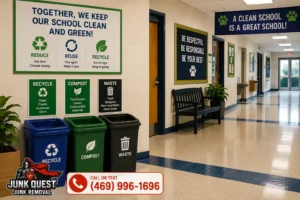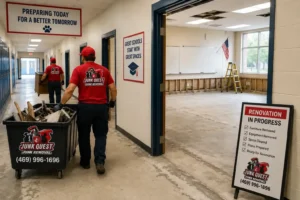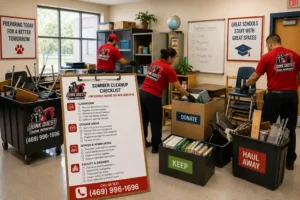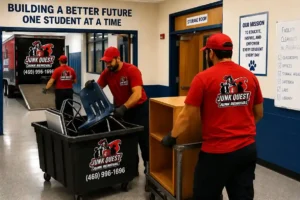
School building organization starts with removing what is no longer used, not with rearranging what is already there. Unused furniture, retired equipment, and storage backlogs take up the space a school needs to organize anything else. Clear those out first, then put a maintenance routine in place so the backlog does not rebuild over the school year.
Key Takeaways
- Shared spaces without an assigned owner collect clutter faster than individual classrooms.
- Removing unused furniture first makes any organizing system easier to apply to what remains.
- Blocked exits and overcrowded storage rooms can create fire code problems, not just appearance problems.
- A mid-year check of shared spaces catches buildup before it becomes a summer-sized project.
- Junk Quest prices by volume with a $120 minimum, so a single storage room costs less than a full building.
- Junk Quest handles the removal and hauling. Sorting decisions and space assignments stay with facilities staff.
Why Do School Buildings Become Cluttered Over Time?
School buildings become cluttered because items get set aside instead of removed. A program ends, furniture gets replaced, supplies go unused, and the leftovers move to a storage room rather than out of the building. Without a scheduled cleanout, that backlog compounds year after year.
Shared spaces absorb the most of it. A storage room, a hallway, or a teacher workroom belongs to everyone and to no one in particular, so nobody is accountable for clearing it. An individual classroom stays in better shape because one teacher answers for that space.
Which Areas of a School Collect the Most Unused Items?
Storage rooms, supply closets, hallways used for overflow, and shared workrooms collect the most. Each one absorbs surplus from several classrooms or departments at once, which is why they fill faster than any single room.
| Area | What builds up | What typically comes out |
| Storage rooms | Retired curriculum materials, outdated equipment | Broken shelving, obsolete AV carts, damaged furniture |
| Hallways | Furniture and boxes used as overflow storage | Anything not returning to a classroom |
| Supply closets | Duplicate and expired supplies | Expired stock, broken storage bins |
| Shared workrooms | Surplus furniture pushed in from other rooms | Unused desks, chairs, and filing cabinets |
Storage cleanout services follow the same sequence in commercial buildings, and the process carries over to school storage rooms without much change.
How Does Removing Unused Furniture Make a Space Easier to Manage?
Removing unused furniture frees the floor space that organizing actually depends on. A room packed with desks nobody uses cannot be reorganized into a usable room. It can only be rearranged. Take the unused pieces out and the remaining layout options open up.
Functional furniture does not have to go to a landfill. Schools can flag pieces worth keeping in circulation before pickup, and our guide to donating office furniture instead of throwing it away covers how that sorting works in practice.
What Does It Cost to Clear Out a School Building?
Cost comes down to volume: how much leaves the building, not how many hours the crew spends. Junk Quest prices by volume with a $120 minimum. A single storage room sits at the low end. A building-wide summer clearout is quoted on the total load.
Volume pricing suits phased school projects well. A district can clear two storage rooms in the spring and the rest over summer break without repricing the job from scratch each time.
Does Clutter Affect Fire Code Compliance?
Yes. Blocked exits, overcrowded storage rooms, and hallways used for overflow storage can put a building out of compliance. NFPA 101, the Life Safety Code, sets requirements for means of egress and storage that many districts build their inspection standards around.
That turns a cleanout into a safety task rather than a cosmetic one. Clearing shared spaces on a schedule keeps these areas compliant year-round instead of only in the weeks before an inspection.
How Can Schools Keep Spaces Clear After a Cleanout?
Assign an owner to every shared space, schedule a review instead of waiting for the annual deep clean, and set a rule that items leave the building when a program ends or equipment is replaced. Without that, a cleared storage room refills.
A short mid-year walkthrough of shared spaces does most of the work. Catching a hallway that has started collecting boxes in January is a far smaller job than clearing it in June.
When Should a School Bring In a Removal Crew?
Bring in a crew when the job spans multiple storage rooms, involves heavy furniture, or has to finish inside a fixed window like summer break. Custodial staff can clear a single closet. A building-wide clearout on a six-week window pulls them off their normal work and creates a second problem.
Two of our guides cover the scope directly: what items office junk removal companies take sets out what a crew will and will not haul, and the benefits of professional office junk removal explains where the labor and disposal savings come from on larger jobs.
Where Junk Quest Serves
Junk Quest provides commercial cleanout services to schools across North Dallas, including McKinney, Frisco, Allen, Plano, Prosper, Wylie, and Garland. That covers furniture removal, equipment hauling, and clearing storage rooms ahead of a reset. Our commercial junk removal services across North Dallas set out the full scope.
Schedule Your School Cleanout
Planning a summer clearout? Get a no-obligation upfront quote from Junk Quest. Call (469) 996-1696 or visit Junk Quest to book your school cleanout. Backed by 900+ reviews.
Junk Quest
7149 Van Tuyl Pkwy, McKinney, TX 75070
(469) 996-1696
Backed by 900+ reviews | No-obligation upfront quote
Frequently Asked Questions
1. Who decides what gets removed during a school cleanout?
The school does. Facilities staff or an administrator marks what leaves before the crew arrives. Junk Quest handles the lifting, loading, and disposal, not the decision about which items are surplus.
2. Can a school cleanout happen while classes are in session?
Yes. Most in-term clearouts work around the bell schedule, with the crew given a fixed access window and a route that avoids occupied areas. Booking outside instructional hours keeps disruption down.
3. What happens to school furniture that is still in good condition?
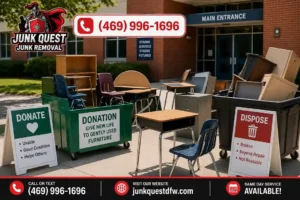
Functional pieces can be routed toward donation or recycling rather than disposal. Flag those items separately before pickup so they are loaded apart from the discard pile.
4. Does Junk Quest take old classroom electronics?
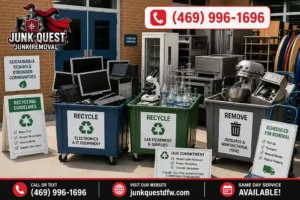
Monitors, projectors, printers, and lab equipment are handled through electronic waste channels rather than the general disposal stream. Let the crew know in advance so those items are kept separate when the trailer is loaded.
5. Does furniture need to be moved to a central spot before the crew arrives?
No. The crew removes items from the rooms they sit in. Clearing a path to the door and unlocking the affected rooms is all the prep that is needed.