Commercial suite cleanouts in Texas follow a set order. The landlord confirms the tenant has abandoned the space, photographs and lists everything left behind, then stores anything that may be worth something. Under Texas Property Code Section 93.002, the landlord may dispose of that stored property if the tenant doesn’t claim it within 60 days after being notified by certified mail. Trash and broken items with no value are usually hauled right away so the suite can be prepared for the next tenant.
Key Takeaways
- Texas law presumes a commercial tenant has abandoned a space when they’ve removed enough property, outside the normal course of business, to show they probably intend to leave.
- A landlord may remove and store property left in an abandoned space. If the tenant doesn’t claim it within 60 days of a certified-mail notice, the landlord may dispose of it.
- Photograph and list every room before anything is moved.
- Separate obvious trash from items that may be worth something, so the cleanup and the storage steps happen in the right order.
- A junk removal crew can haul the trash right away, then clear the unclaimed items once the 60 days are up.
When Can a Landlord Remove a Commercial Tenant’s Property in Texas?
A landlord can remove a commercial tenant’s property once the tenant has abandoned the space. Texas Property Code Chapter 93 covers commercial leases. Normally, a landlord can’t keep a tenant out of the space without going to court. Section 93.002 makes an exception for removing the contents of a space the tenant has abandoned.
The same section says when a tenant is presumed to have abandoned the space. That happens when the tenant has removed goods, equipment, or other property in an amount large enough to show they probably intend to leave, and the removal isn’t part of their normal business.
Property managers commonly record other signs too:
- The rent is unpaid and the tenant isn’t responding
- Utilities have been shut off at the tenant’s request
- Keys were left behind, or the tenant said they were leaving
- Signs were taken down, or business listings show the location as closed
Your lease may also define abandonment and set its own steps. Follow both the lease and the statute.
What Does Texas Law Require Before Disposing of Left-Behind Property?
Store it and send notice first. Under Section 93.002(e), a landlord may remove and store any of the tenant’s property that’s still in an abandoned space. The landlord may dispose of the stored property if the tenant doesn’t claim it within 60 days of the date it was stored.
The notice must go by certified mail to the tenant’s last known address and say the property may be disposed of if it isn’t claimed within 60 days. USPS Certified Mail gives you proof of mailing and a delivery record. Add Return Receipt if you want a signature.
In practice, that makes a three-step process:
| Step | What Happens | Who Does It |
| 1. Document | Photograph every room and list everything left behind | Property manager |
| 2. Remove and store | Haul obvious trash; move items that may be worth something to a locked room or storage unit; send the certified-mail notice | Property manager, with a junk removal crew for the trash |
| 3. Dispose | After 60 days with no claim, donate, recycle, or haul the stored items | Property manager with a junk removal crew |
Obvious trash, such as food waste, torn boxes, and broken fixtures, is usually cleared during step 2 because it’s not worth storing. If you’re unsure about an item, store it.
What Should Be Documented Before the Cleanout Starts?
Everything. Photos and a written list protect you if the former tenant later says property was lost or damaged.
- Photos and video: walk every room, closet, and storage area, including the back of the suite and any attached warehouse space.
- Written list: describe each item, its condition, and where it was found.
- Meter readings and keys: record utility meter readings and collect every key and access card.
- Letters and receipts: keep copies of the certified-mail notice and its receipt.
- Condition of the suite: note any damage beyond normal wear and tear.
Share the list with the removal crew so everyone knows which items stay for storage and which go on the truck.
What Do Tenants Usually Leave Behind in a Commercial Suite?
Tenants usually leave what’s hardest to move or sell. The mix depends on the type of business.
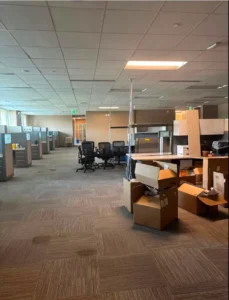
- Office tenants: desks, chairs, cubicle panels, filing cabinets, old computers, and boxes of paper
- Retail tenants: display fixtures, shelving, counters, mannequins, and leftover stock
- Restaurants: tables, chairs, and small kitchen items (equipment connected to gas or plumbing needs a licensed tradesperson to disconnect it)
- Warehouse and flex-space tenants: pallet racking, pallets, workbenches, and scrap
- All tenants: trash, broken furniture, décor, and signs
Paper files and computers may hold customer or employee information, so don’t put them in an open dumpster. Store them with the tenant’s other property during the 60 days. After that, shred the files and wipe or destroy the drives, following the approach in the FTC’s Disposal Rule guidance, which applies to landlords. Junk Quest handles electronic waste disposal for the hardware once the data is dealt with.
How Does the Commercial Suite Cleanout Itself Work?
It usually takes two visits. The first clears the trash, and the second removes whatever’s left after the 60 days end.
First visit:
- Haul trash, food waste, and broken items that aren’t worth anything
- Leave items marked for storage in place, or in the area you’ve set aside for them
- Clear enough space for inspection and repair estimates
Second visit (after 60 days with no claim):
- Pick up unclaimed items
- Sort them for donation, recycling, and disposal. Usable desks and chairs can often be donated, as covered in donating office furniture instead of throwing it away.
- Clear any remaining fixtures the lease lets you remove
Junk Quest’s office cleanout services cover office suites, retail spaces, and flex space across North Dallas. For storefronts, see our retail store cleanout guide. For larger jobs that include warehouse space, see our office and warehouse cleanout service in Carrollton.
Evening and weekend scheduling avoids disturbing neighboring tenants. Pricing is based on trailer volume and includes labor, hauling, taxes, and disposal, and you get the quote before work begins.
Handle Commercial Suite Cleanouts by the Book
The order matters more than the speed. If you skip the documentation or the certified-mail notice, the landlord could be exposed to a claim from the former tenant. If you follow the steps, the trash can still go in the first week, so repairs and showings don’t have to wait for the full 60 days.
Get the Suite Ready for Your Next Tenant
Junk Quest helps property managers and commercial landlords across North Dallas clear vacated suites, from trash removal on the first visit to the final haul after the 60 days. Call (469) 996-1696 or contact Junk Quest online for an upfront quote.
Frequently Asked Questions
1. Can a landlord throw away a commercial tenant’s belongings in Texas?
Yes, but only after the right steps. Texas Property Code Section 93.002 lets a landlord dispose of stored property from an abandoned space if the tenant doesn’t claim it within 60 days of a certified-mail notice.
2. How long do I have to store property left in a commercial suite?
60 days from the date the property is stored, after sending a certified-mail notice to the tenant’s last known address. Your lease may add its own terms.
3. Can the trash be removed right away?
Yes. Items that aren’t worth anything, such as food waste, torn boxes, and broken fixtures, are usually hauled on the first visit. Store anything that could be worth something until the 60 days are up.
4. What should I do with paper files and computers a tenant left behind?
Store them with the rest of the tenant’s property for the 60 days. Don’t put them in an open dumpster. After that, shred the files and wipe or destroy the drives before the hardware is recycled.
5. Are unclaimed items donated after the 60 days?
Yes, when they’re reusable. Furniture and fixtures in usable condition are donated when possible, and the rest is recycled or disposed of responsibly.