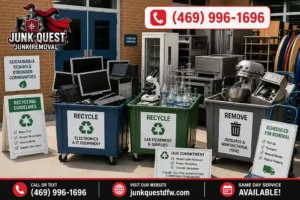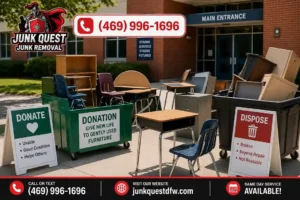
The most effective school waste management tips are setting up clearly labeled recycling and waste stations, scheduling regular cleanouts of storage and shared spaces rather than letting clutter build up, and separating waste streams that require special handling, such as electronics and chemicals, from general trash. Schools generate a wide mix of waste types, from cafeteria food waste to classroom paper to outdated equipment, which makes a single-bin approach far less effective than a sorted system. Waste management works best as an ongoing routine rather than a periodic cleanup, since daily habits determine how much ends up needing a large-scale removal later.
Key Takeaways
- Schools generate a wider mix of waste types than most buildings, which makes sorted disposal more effective than a single-bin approach.
- Cafeteria food waste is often the largest waste category by weight, followed by paper and packaging.
- Electronics and hazardous lab materials require separate handling and shouldn’t be combined with general trash.
- Reducing waste at the source, through recycling stations and reusable materials, is more effective than managing volume after the fact.
- Texas waste disposal regulations apply to schools the same way they do to other commercial properties.
- Maintenance and renovation waste should be handled separately from routine daily school waste.
- Large cleanouts are easiest to schedule during summer, winter break, or the gap between semesters.
Why Does Waste Management Matter for Schools Specifically?
Waste management matters for schools specifically because a campus produces more waste per square foot, across more categories, than most other building types. A single hallway can hold classroom paper, packaging, food waste, and equipment awaiting disposal at the same time.
Poor sorting compounds over an academic year into storage backlogs and larger cleanout projects than a well-managed system would produce. Texas waste disposal rules administered by the Texas Commission on Environmental Quality apply to schools the same way they apply to other commercial properties, which makes compliance a practical consideration alongside general tidiness.
What Types of Waste Do Schools Typically Generate?
Types of waste schools typically generate are general trash, recyclable paper and packaging, cafeteria food waste, electronics and outdated technology, and occasionally hazardous materials from science labs or maintenance operations.
Sorting matters because mixing recyclables with general trash reduces how much actually gets recycled, and putting electronics or chemicals into standard trash creates compliance problems. The list of what items office junk removal companies take covers how these categories are typically separated in a commercial or institutional removal. Outdated technology should be routed through electronic waste disposal rather than standard trash.
School Waste Stream Breakdown
| Waste type | Handling | Notes |
| General trash | Standard disposal | Reduce volume through better sorting elsewhere |
| Paper and packaging | Recycling | Highest-volume recyclable stream in most schools |
| Cafeteria food waste | Compost where available, otherwise standard disposal | Often the largest single waste category by weight |
| Electronics | E-waste recycling | Requires separate handling, not standard trash |
| Lab and hazardous materials | Specialized disposal per district policy | Never combine with general waste |
How Can Schools Reduce the Amount of Waste That Needs Disposal?
Schools can reduce the amount of waste that needs disposal by setting up clearly labeled recycling stations, encouraging reusable materials in cafeterias and classrooms, and scheduling regular reviews of storage areas so items are donated or recycled before they become part of a larger cleanout.
The EPA’s Sustainable Materials Management program provides resources and strategies organizations can use to reduce waste generation, improve recycling efforts, and manage materials more efficiently over time, which schools can adapt at a smaller scale. Reducing waste at the source is generally more effective than managing a larger volume after the fact.
How Should Schools Handle Recycling for Paper and Packaging?
Schools should handle recycling for paper and packaging by placing clearly labeled bins in classrooms, offices, and common areas, and coordinating pickup schedules that match actual volume rather than defaulting to municipal minimums.
Guidance on recycling or donating items in North Dallas applies to school paper and packaging the same way it applies to household materials. Items in usable condition, including surplus furniture and unopened supplies, are often better routed to donation than to a recycling stream.
What Should Be Done With Waste From Maintenance or Renovation Work?
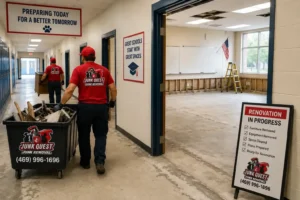
Waste from maintenance or renovation work, such as old fixtures, construction materials, or discarded equipment, should be handled separately from routine daily waste, since it’s typically higher volume and may include materials that need special disposal.
The process for disposing of warehouse waste responsibly applies to school maintenance and renovation debris as well, since both involve high-volume mixed loads that don’t fit standard collection schedules.
How Should Schools Schedule Large Cleanouts Around the Academic Calendar?
Schools should schedule large cleanouts during summer break, winter break, or the gap between semesters, when classrooms and storage areas are empty and a crew can work without disrupting instruction. Because most campuses target the same few weeks, booking the removal before the term ends gives a school more scheduling flexibility than waiting until the building is already cleared out.
Access matters as much as timing. Loading dock availability, gate codes, and elevator access all affect how quickly a crew can clear a building, and confirming these details in advance keeps a large removal to a single visit. Junk Quest works with schools and administrative facilities acrossMcKinney, Frisco, Allen, Plano, Prosper, Wylie, and Garland, and handles office and commercial cleanouts in McKinney on the same volume-based pricing model.
Schedule Your School Cleanout
Junk Quest removes excess materials, outdated equipment, and facility clutter from schools across McKinney, Frisco, Allen, Plano, and Prosper. Pricing is volume-based, calculated on how much space the load takes up on the trailer, with a $120 minimum. Call (469) 996-1696 or visit Junk Quest for a no-obligation upfront quote. Backed by 900+ reviews.
Junk Quest DFW
7149 Van Tuyl Pkwy, McKinney, TX 75070
(469) 996-1696
junkquestdfw.com
Frequently Asked Questions
1. What does a school cleanout actually involve?
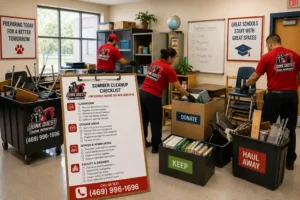
A school cleanout covers removing excess materials from classrooms, storage rooms, administrative offices, and outdoor areas. That typically includes old desks and chairs, filing cabinets, outdated technology, broken equipment, and accumulated storage clutter. Staff don’t need to move items to a central collection point beforehand.
2. Which areas does Junk Quest serve for school cleanouts?
Junk Quest serves schools and administrative facilities in McKinney, Frisco, Allen, Plano, and Prosper, along with the surrounding North Dallas area. The company has operated from its McKinney location since 2019.
3. How is a school cleanout priced?
Pricing is volume-based, calculated on how much space the load occupies on the trailer rather than by weight or by the hour. The minimum charge is $120, and schools receive a no-obligation upfront quote before any loading begins.
4. Can old classroom computers and electronics be removed in the same visit?
Yes. Outdated computers, monitors, printers, and projectors can be removed alongside furniture and general clutter, then routed to e-waste recycling rather than standard disposal.
5. Does Junk Quest handle lab chemicals or hazardous materials?
No. Laboratory chemicals, solvents, paints, and similar hazardous materials need to go through a hazardous waste contractor under the district’s own disposal procedure. Junk Quest removes general school waste, furniture, equipment, and electronics.